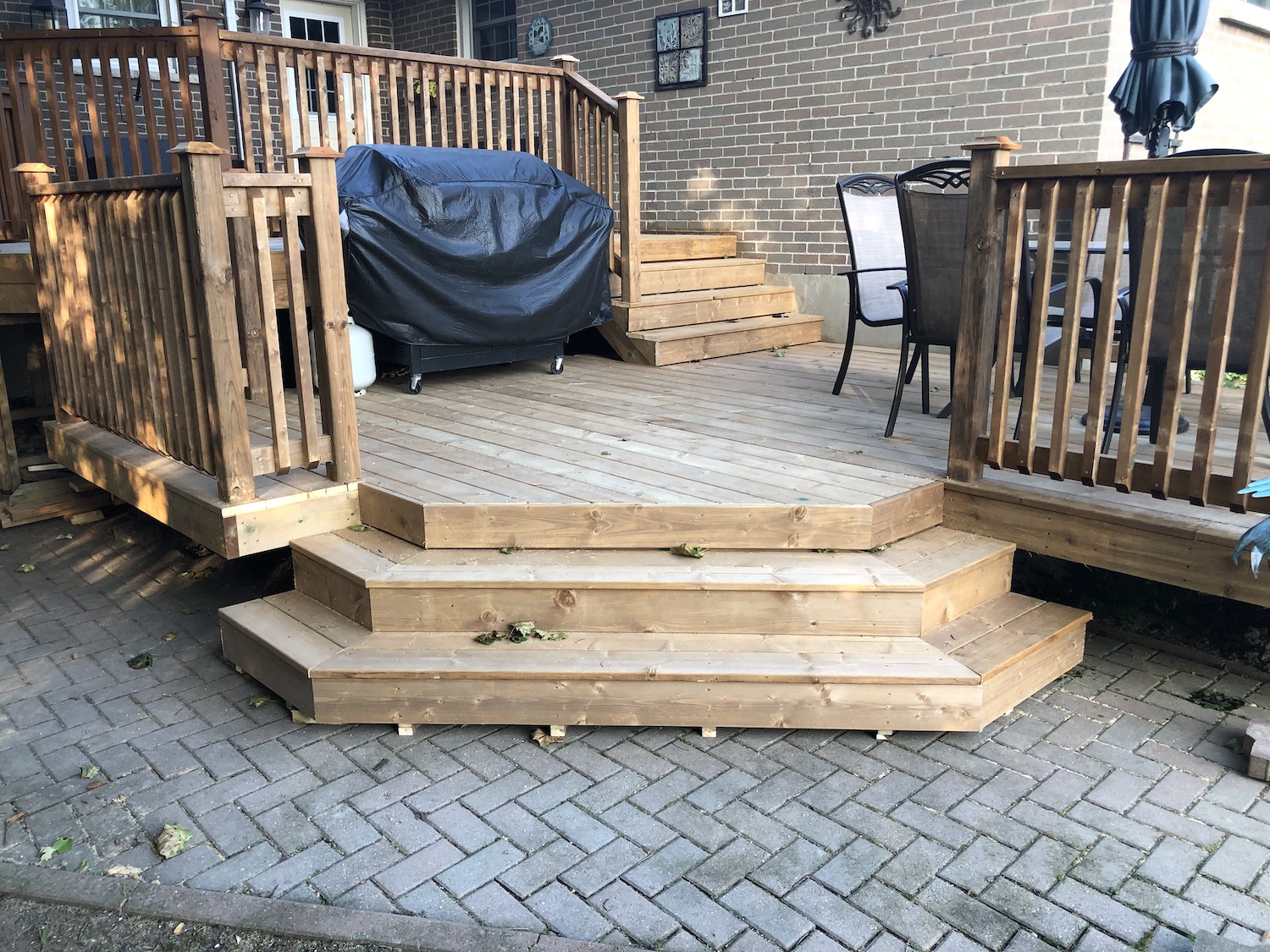
Your deck has made it through another Toronto winter, but the boards are greying, a railing wiggles, and you are starting to wonder whether this is a weekend of repairs or a full rebuild. It is one of the most common questions we hear from GTA homeowners, and the honest answer is: it depends on where the damage lives. This guide walks you through how to inspect your deck the way a builder would, which problems are cosmetic versus structural, and how repair and replacement compare on cost in 2026.
Start with a proper inspection
Before you price anything, you need to know what you are actually dealing with. A deck can look tired on the surface while the framing underneath is sound, or it can look fine on top while the structure that holds it up is quietly failing. Walk your deck slowly and check each of these areas. Pick an overcast day after rain if you can, since moisture makes rot and movement easier to spot.
Surface boards (the decking)
These are the boards you walk on, and they take the worst of our freeze-thaw cycles. Press a screwdriver or an awl into any board that looks dark, feels soft, or is cupping. If the tip sinks in easily, that board is rotting. Scattered soft boards are normal wear on a 10-plus-year-old deck and are usually a straightforward replacement. Widespread softness across most of the surface is a different signal.
Joists and beams (the framing)
Get underneath the deck with a flashlight if you have clearance, or peer between the boards. Joists are the horizontal members that carry the decking; beams carry the joists. Look for dark staining, soft spots, and cracks, paying special attention to where joists sit on the beam and where wood meets metal hangers. One compromised joist can often be sistered or replaced. Rot running through many joists points toward replacement.
Ledger board and flashing
The ledger is the board that bolts your deck to the house, and it is the single most important safety component. Most catastrophic deck collapses trace back to a failed ledger connection. Confirm it is fastened with proper lag bolts or structural screws, not just nails, and that there is flashing directing water away from the wall. If the ledger is pulling away from the house, rotting, or you see water staining on the siding behind it, treat that as urgent.
Posts and footings
Posts are the vertical supports; footings are the concrete below them that reach past the frost line. In Ontario, footings must extend deep enough to sit below frost depth, or our winters will heave them. Check whether posts are plumb, whether their bases are rotting where they meet concrete or soil, and whether any footing has lifted, tilted, or cracked. A deck that has visibly shifted or become out of level over a season or two is often telling you the footings have moved.
Railings and fasteners
Grab the railing and give it a firm shove. It should not flex, wobble, or move at the posts. Loose railings are a serious fall hazard and, on a raised deck, a real risk to your family and guests. While you are at it, scan for rusted, backing-out, or missing screws and nails. Corroded fasteners weaken every connection they hold, and rusty streaks on the wood are a giveaway.
Cosmetic or structural? Knowing the difference
Not every ugly deck is an unsafe deck. Greying, faded stain, minor surface cracks (checking), and a few splinters are cosmetic. They affect how the deck looks, not whether it holds you up, and they are usually solved with cleaning, sanding, and re-staining, or by resurfacing. Structural problems live in the framing, ledger, posts, and footings. These affect load-bearing capacity and safety, and they are the ones that decide repair versus replace.
Use the table below as a quick gut-check. Every situation deserves a hands-on look, but this is how these issues typically break down.
| Problem you see | Usually a repair | Usually a replace |
|---|---|---|
| Surface boards rotting | A few soft boards over sound framing | Most boards soft or cupped throughout |
| Wobbly railing | Re-secure or rebuild the railing section | Railing loose because posts/framing are rotted |
| One damaged joist | Sister or swap the single joist | Rot found across many joists |
| Widespread rot | Rarely | Framing compromised — rebuild |
| Footing heave or movement | Isolated, minor re-levelling | Multiple footings shifted / above frost line |
| Ledger pulling away | Rarely — only if caught very early | Separation, rot, or water damage at the wall |
| Greyed / splintered but sound | Clean, sand, re-stain or resurface | Not needed |
Red flags that mean replace
Some findings override everything else. If you see any of these, stop using the deck for large gatherings and get it inspected right away.
- Frost-heaved footings. Posts that have lifted or tilted because footings sit above the frost line will keep moving every winter. You cannot reliably patch your way out of this.
- Ledger separation. Any gap opening between the deck and the house, or rot where they meet, is a collapse risk.
- Widespread rot. When soft, punky wood shows up across the joists and beams, the bones of the deck are gone.
- Built without a permit or not to code. Older GTA decks were sometimes built with undersized framing, no proper footings, or nailed ledgers. If your deck was never permitted or clearly does not meet current standards, repairs may not bring it into compliance.
Ontario decks are governed by the Ontario Building Code, and most deck work in Toronto requires a permit. You can review the requirements through the City of Toronto's building permit process. We cover this in more depth in our guide to deck safety and the building code in Toronto.
What it costs in the GTA (2026)
Pricing always depends on size, height, materials, and access, but here are realistic 2026 ranges for the Greater Toronto Area. Minor repairs, such as swapping a few boards, re-securing a railing, or sistering a joist, typically run from a few hundred dollars to around $2,500. Larger repairs and resurfacing land in the $3,000 to $9,000 range. A full teardown and rebuild of an average deck generally starts around $12,000 and climbs from there, with pressure-treated wood at the lower end and composite at the higher end.
The math that matters is this: if repairs will cost more than roughly half of a rebuild, or if you would be pouring money into a structure that is nearing the end of its life anyway, replacement is usually the smarter long-term spend. Our composite versus wood cost and lifespan comparison can help you weigh materials if a rebuild is on the table.
When resurfacing makes sense
There is a middle path many homeowners miss. If your framing, ledger, posts, and footings are genuinely sound but the decking and railings are worn out, you can resurface: new boards and new railings on the existing structure. This is often the sweet spot for a deck that is structurally fine but tired, and it is a natural moment to switch to low-maintenance composite decking so you are not re-staining every couple of years. Resurfacing only works when the structure passes inspection, so this is exactly why the inspection comes first.
The lifespan question
A pressure-treated deck in our climate typically lasts about 10 to 15 years before the framing starts to give out, even with good maintenance. Our freeze-thaw winters are hard on wood and fasteners, and water that gets into joints expands as it freezes, prying connections apart season after season. If your deck is past the 15-year mark and showing structural wear, repairs tend to become a losing game. Regular upkeep genuinely extends that life, and our winter deck care guide walks through how to protect it between seasons.
Frequently asked questions
How do I know if my deck is safe to keep using?
Check the ledger connection, the railings, and the footings first, since those are the components tied to collapse and fall risk. If the ledger is solid, railings do not move, and the deck is level and stable, it is likely safe for normal use. Any separation at the house, wobbling railing, or shifted footing warrants a professional inspection before you host on it.
Can I just replace the boards and keep the frame?
Often, yes, as long as the framing, posts, and footings are sound. That is resurfacing, and it is a cost-effective way to get a like-new deck. The catch is that the structure has to pass inspection first, because new boards on failing framing only hides the problem.
Do I need a permit to repair my deck in Toronto?
Like-for-like maintenance such as replacing a few boards generally does not, but structural changes, new footings, or decks above a certain height typically do. Because the rules depend on the specifics, it is worth confirming with the City before major work. We handle permitting as part of our deck building and repair services.
Is composite worth it over pressure-treated wood?
If you are rebuilding and plan to stay in your home, composite usually pays off through decades of low maintenance and no annual staining. Wood costs less upfront. We break down the trade-offs as a composite deck builder in Toronto and in our detailed materials comparison.
The right answer starts with an honest look at your deck's bones, not its surface. If you would like a straightforward assessment and a clear recommendation, Deck Master Inc. has served Toronto and the GTA since 2004, is WSIB-insured, and is a three-time HomeStars "Best of" winner with a 5.0 rating. See examples of our work in our project gallery, or book your deck inspection today by calling 647-349-6585.