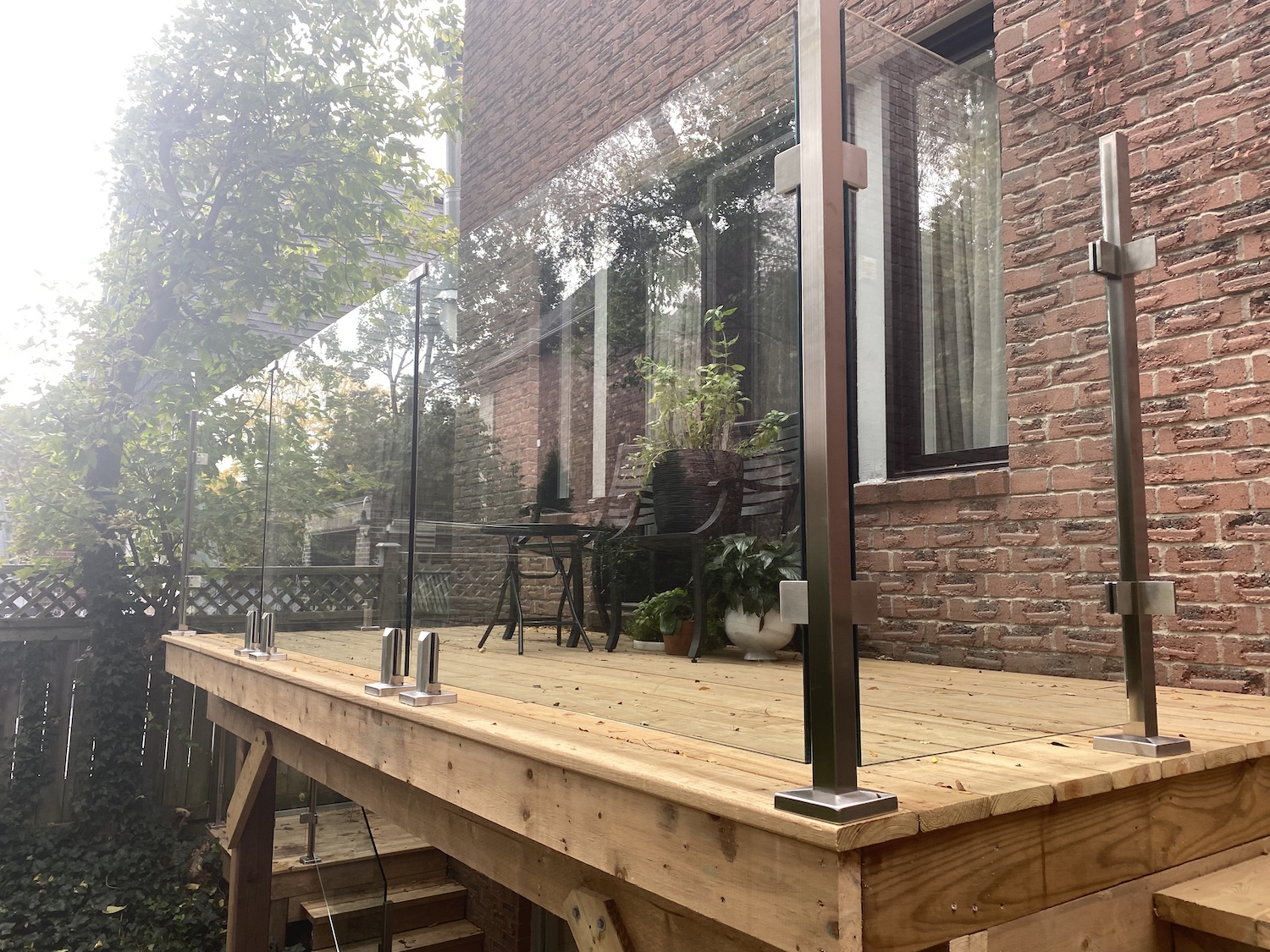
If you're pricing glass deck railings in Toronto or the GTA, expect a wide range — and a lot of confusing quotes. This 2026 guide breaks down realistic installed pricing per linear foot, what actually drives the number, and how Ontario Building Code requirements affect your project. As a WSIB-insured builder working across the GTA since 2004, we quote these systems every week, so the figures below reflect what homeowners are genuinely paying this year.
What glass railings cost in the GTA in 2026
Glass railing pricing is almost always expressed per linear foot, installed — meaning materials, hardware, and labour together. The two main systems are framed glass (glass panels held inside a top and bottom aluminum frame) and frameless/spigot glass (thick tempered panels anchored by stainless spigots or a base shoe, with no top rail). Frameless is the premium look, and it costs accordingly because the glass is thicker and the hardware is structural.
| Railing type | Typical 2026 GTA cost (per linear foot, installed) | Notes |
|---|---|---|
| Framed glass | $130 – $220 | Aluminum top/bottom rail; tempered panels; most forgiving on uneven decks. |
| Frameless / spigot glass | $200 – $400+ | Thick (12–13.5 mm) tempered or laminated glass; stainless spigots or base shoe; premium view. |
| Aluminum picket | $60 – $120 | Powder-coated; lowest maintenance; strong value for perimeter runs. |
| Cable railing | $90 – $170 | Stainless cable + posts; needs rigid framing to resist cable tension. |
| Wood | $40 – $90 | Lowest upfront cost; highest ongoing maintenance (staining, rot). |
As a rule of thumb, a typical 40-linear-foot deck perimeter in framed glass lands somewhere around $5,200–$8,800 installed, while the same run in frameless glass can reach $8,000–$16,000+. The spread is real, and it comes down to the cost drivers below.
What drives glass railing cost
Glass type and thickness
Framed panels are usually 6–10 mm tempered glass. Frameless spigot systems need 12 mm or 13.5 mm glass because the panel itself carries the load without a top rail. Thicker glass costs more per panel and is heavier to handle. You'll also choose between clear, low-iron ("ultra-clear"), tinted, or frosted glass — low-iron carries a premium of roughly 10–20% but removes the greenish edge you get with standard float glass.
Tempered vs laminated safety glass
All exterior guard glass in Ontario must be safety glass. Tempered glass is heat-treated so it shatters into small, blunt granules instead of shards. Laminated glass bonds two layers with an interlayer so that, if it breaks, the fragments stay in place. Many frameless designs — especially elevated decks or balconies — use tempered-laminated glass, which satisfies both the strength and the "if it breaks, it holds" requirements. Laminated adds cost but is often the safest specification for higher decks.
Hardware, deck height, and layout
Stainless spigots, standoffs, and base shoes are structural components, and marine-grade stainless costs more than the base tier — but it's the right call for GTA winters and road salt. Height matters too: a deck more than about 1.8 m off the ground needs a taller guard and heavier anchoring. Finally, layout complexity is a major multiplier. Long straight runs are cheap per foot; short returns, corners, gates, and stairs each add custom panels and labour. Glass on stairs, in particular, often involves angled or stepped panels that carry a meaningful premium.
Ontario Building Code: guards, heights, and loads
Glass railings on a deck are guards under the Ontario Building Code, and they aren't optional decoration — they're a life-safety system with specific rules. The requirements below come from O. Reg. 332/12 (the Ontario Building Code), and any deck over a certain height typically needs a City of Toronto building permit.
- A guard is generally required wherever a walking surface is more than 600 mm (about 24 in) above the adjacent level.
- For most residential decks, guard height is at least 900 mm; once the deck surface is more than about 1.8 m above grade, the guard must be at least 1070 mm (roughly 42 in) high.
- Guards must resist specified loads — including a horizontal point and distributed load — which is exactly why frameless panels need thick glass and properly engineered spigots.
- Openings in a guard must be sized so a 100 mm sphere cannot pass through; glass panels naturally satisfy this, but panel gaps and base details still have to comply.
Requirements vary with your specific deck height and configuration, and municipalities across the GTA interpret permit thresholds slightly differently. Always confirm the current code edition and permit requirement for your project before ordering glass. A reputable installer builds compliance into the quote rather than treating it as your problem.
Maintenance and cleaning
The honest trade-off with glass is visibility of dirt. Glass shows water spots, pollen, fingerprints, and the film that GTA rain and road grit leave behind, so plan on wiping panels down several times through the season with glass cleaner or a vinegar-and-water mix and a squeegee. The hardware itself is low-maintenance: quality stainless spigots and powder-coated aluminum frames just need an occasional rinse. There's no staining, sanding, or sealing — unlike wood — so the ongoing labour is cleaning, not refinishing.
Glass vs aluminum: the practical trade-off
Aluminum picket railing costs roughly a third to a half of frameless glass and hides dirt far better, which is why it remains the GTA workhorse for perimeter runs and side yards. Glass wins on one thing decisively: the unobstructed view. If your deck overlooks a ravine, a pool, the lake, or a landscaped yard, glass is what preserves that sightline. Many homeowners split the difference — glass on the primary view-facing side, aluminum on the rest — to control budget without giving up the payoff. If you're weighing the two, our aluminum vs glass railings guide compares them in more detail, and you can browse both in our railings services overview or see real installs in the project gallery.
Are glass railings worth it?
For the right deck, yes. Glass railings deliver two things that justify the premium: they make outdoor space feel larger and more open by removing visual barriers, and they tend to read as a high-end finish to buyers, which supports resale on view properties. They're less compelling on a low deck facing a fence, where you're paying for a view you don't have. If your deck has something worth looking at, glass usually earns its cost; if it doesn't, aluminum railings give you most of the modern look for less. To sketch a budget for your exact perimeter, try our railing cost calculator, or explore full glass railing options to see framed and frameless side by side.
Frequently asked questions
How much does a glass deck railing cost in Toronto?
In 2026, framed glass typically runs $130–$220 per linear foot installed, and frameless/spigot glass runs $200–$400+ per linear foot. A standard 40-foot deck perimeter therefore lands roughly between $5,200 and $16,000 depending on system, glass thickness, and layout complexity such as stairs and corners.
Do I need a permit for a glass deck railing in the GTA?
Often, yes — especially when the railing is part of a new or rebuilt deck, or the deck exceeds the height at which a permit is required. Guards are a Building Code life-safety element, so it's worth confirming with your municipality; in Toronto you can check requirements through the City's building permit page linked above.
Is tempered or laminated glass better for deck railings?
Both are safety glass. Tempered is standard and breaks into blunt granules; laminated holds fragments in place if it breaks. For elevated decks and frameless designs, tempered-laminated glass is frequently specified because it combines strength with fragment retention — the safest choice for higher installations.
How is glass railing different from cable railing?
Glass gives a solid, wind-blocking, view-preserving barrier and shows dirt; cable gives a lighter, industrial look with thin horizontal lines and needs rigid framing to hold cable tension. Cable often costs less than frameless glass. Our cable railing guide covers where it fits best.
Ready to price glass railings for your deck? Deck Master Inc. has built decks, railings, and pergolas across Toronto and the GTA since 2004 — WSIB-insured, a three-time HomeStars "Best of" winner, and 5.0-rated. Call 647-349-6585 or request a free quote, and we'll spec a code-compliant glass railing tailored to your view and your budget.