Deck Safety & Ontario Building Code Requirements for Toronto Homeowners
Guides

Deck Safety & Ontario Building Code Requirements for Toronto Homeowners

Deck Master Team
Expert Insights
March 16, 2026
13 min read

What You'll Learn

Complete guide to deck safety and Ontario Building Code requirements for Toronto homeowners. Railing heights, load capacity, joist spacing, permits, and inspection checklist.

Why Deck Safety Matters More Than You Think

Every year across Ontario, deck collapses and railing failures result in serious injuries and even fatalities. The Electrical Safety Authority and municipal building departments across the GTA report that improperly built decks—particularly older structures and unpermitted DIY projects—represent one of the most common residential safety hazards in the province.

Understanding the Ontario Building Code (OBC) requirements for deck construction is not just about passing inspection. It is about protecting your family, your guests, and your investment. This guide covers every critical safety requirement Toronto homeowners need to know.

Ontario Building Code Requirements for Decks

The Ontario Building Code (OBC) sets minimum standards for residential deck construction across the province. Toronto and individual GTA municipalities may impose additional requirements, but the OBC serves as the baseline.

One of the most frequently violated code requirements involves railing heights:

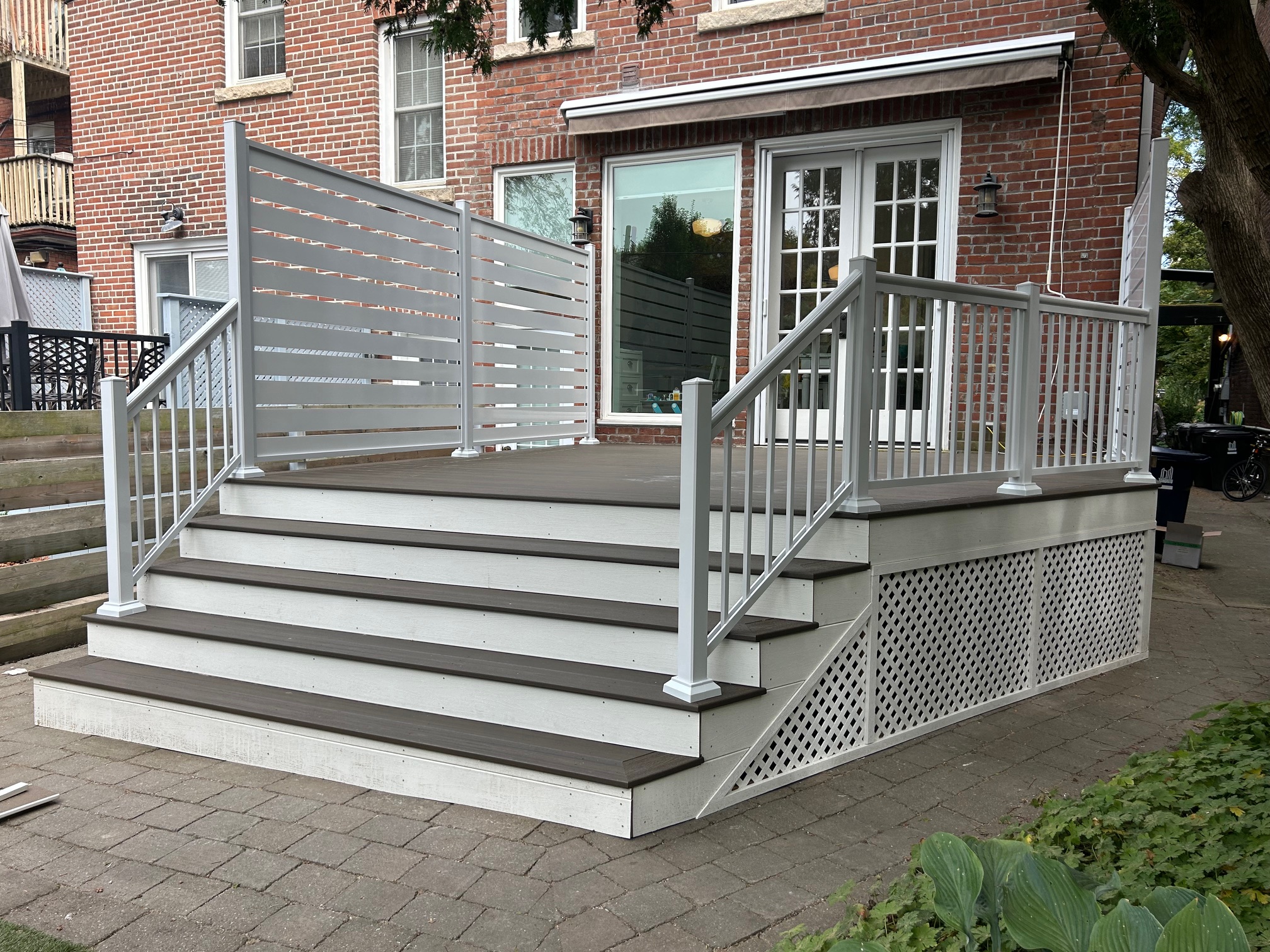
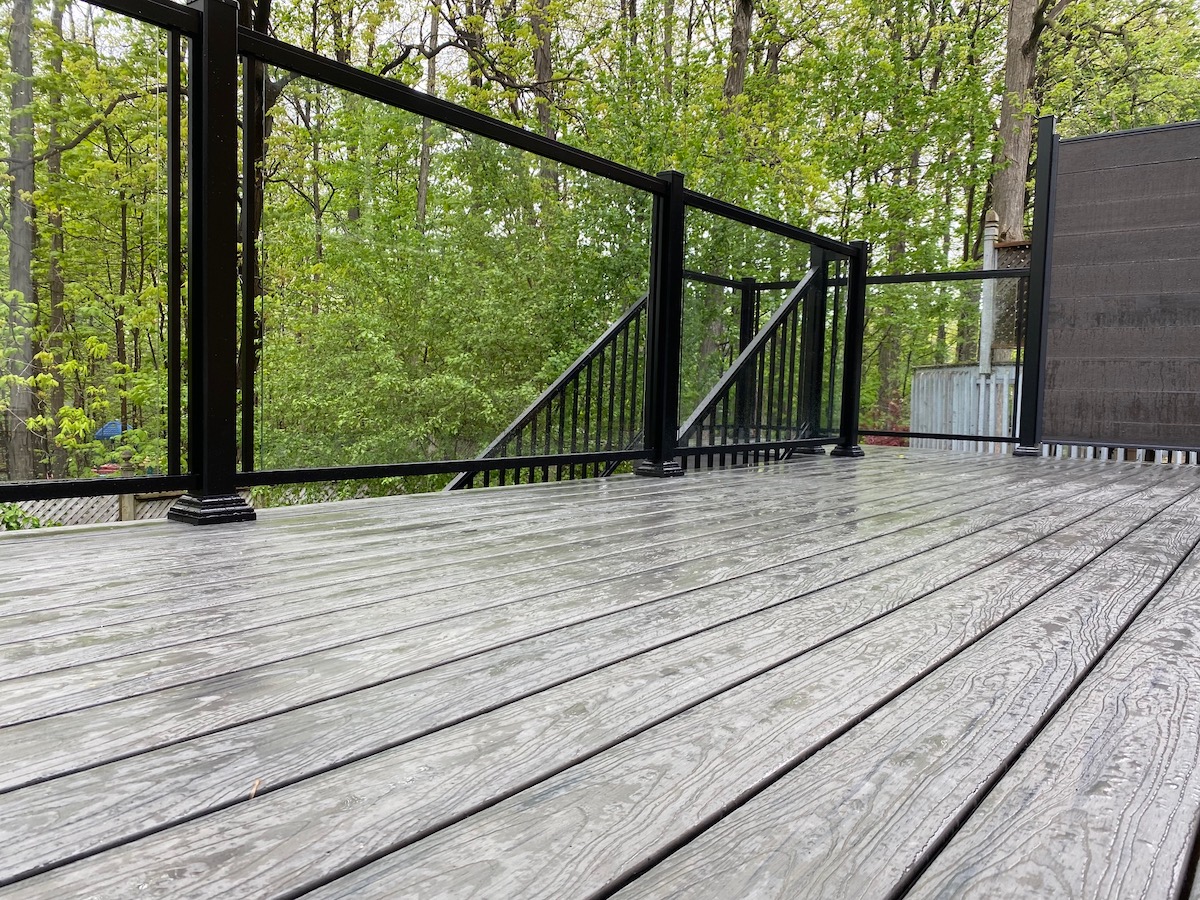
Guard Rail and Railing Heights

Decks 24 inches (600 mm) or more above grade require guards (railings) on all open sides
Minimum guard height: 36 inches (900 mm) for residential decks less than 1,800 mm above grade
Decks over 1,800 mm (approximately 6 feet) above grade require guards of at least 42 inches (1,070 mm)
Baluster spacing: Openings must not allow passage of a 100 mm (4-inch) sphere—this prevents children from slipping through
Horizontal rails: If using horizontal cable or rail designs, the same 100 mm sphere test applies between each horizontal element

The OBC specifies that residential decks must support specific loads:

Structural Load Requirements

Live load: Minimum 1.9 kPa (approximately 40 pounds per square foot)—this accounts for people, furniture, snow, and other variable loads
Dead load: The weight of the deck structure itself, including decking, joists, beams, and railings
Concentrated load: Guards must resist a horizontal force of 0.75 kN per metre applied at the top of the guard
Snow load: Toronto falls in a snow load zone requiring decks to support the weight of accumulated snow—this affects joist sizing and beam specifications

Proper footings are critical for deck safety in Toronto's freeze-thaw climate:

Footing and Foundation Requirements

Frost line depth: Footings must extend below the frost line, which is a minimum of 4 feet (1.2 metres) in the Toronto area
Footing size: Minimum 12-inch diameter for typical residential deck posts, larger for heavy-load situations
Concrete strength: Minimum 20 MPa compressive strength at 28 days
Sonotube requirements: Must extend from below frost line to above grade to prevent frost heave

Joist specifications depend on the span, spacing, and wood species:

Joist Sizing and Spacing

Common joist sizes: 2x8 for spans up to 10 feet, 2x10 for spans up to 13 feet, 2x12 for spans up to 16 feet (using SPF lumber at 16-inch centres)
Maximum joist spacing: Typically 16 inches on centre for most decking materials; some composite manufacturers require 12-inch spacing
Joist hangers: Required at all beam connections—face-nailing alone does not meet code
Blocking: Required at mid-span for joists exceeding 10 feet and at all guard post locations

The ledger board connection—where the deck attaches to the house—is the most common point of failure in deck collapses:

Ledger Board Attachment

Lag screws or through-bolts: The OBC requires mechanical fasteners (not nails) for ledger attachment. Minimum 1/2-inch diameter lag screws or through-bolts at specified spacing
Flashing: A critical waterproofing requirement. Improper or missing ledger flashing is the leading cause of structural rot at the house connection
Prohibited attachment: Ledger boards cannot be attached to cantilevered floor systems, brick veneer without proper blocking, or engineered rim boards without manufacturer approval

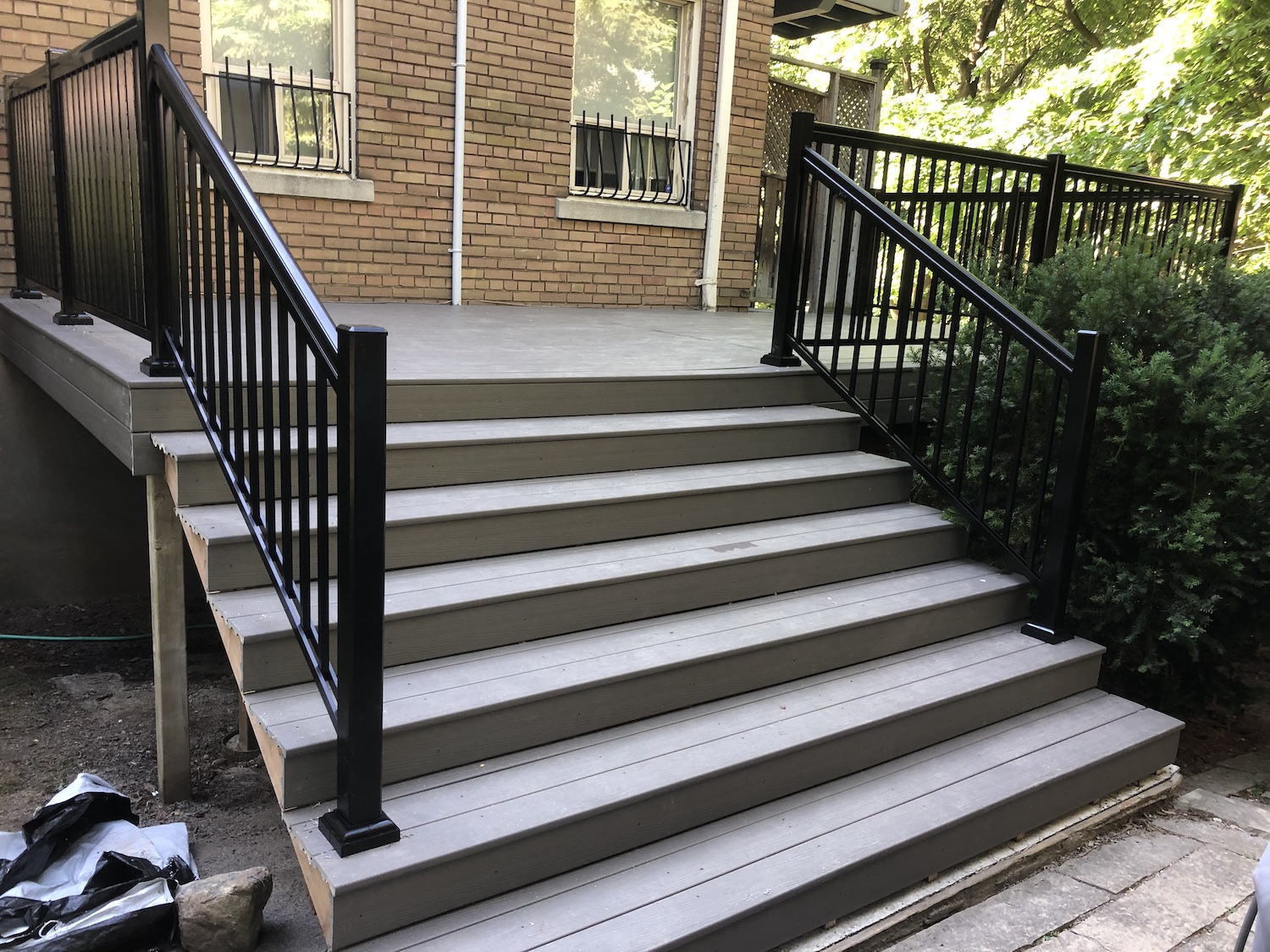
Deck stairs have specific code requirements that are frequently overlooked:

Stair Requirements

Riser height: Maximum 200 mm (approximately 7.87 inches), minimum 125 mm. All risers must be uniform within 6 mm
Tread depth: Minimum 235 mm (approximately 9.25 inches) measured from nosing to nosing
Width: Minimum 860 mm (approximately 34 inches) clear width
Handrails: Required on at least one side for stairs with more than 3 risers. Height between 865 mm and 965 mm measured from the stair nosing
Landing: Required at the top and bottom of every stairway. Minimum dimension equal to the stair width

Common Deck Safety Violations in Toronto

Municipal building inspectors across the GTA consistently flag these issues during deck inspections:

Many older decks use notched posts with the beam simply resting in the notch. Current code requires positive mechanical connections such as post caps, through-bolts, or engineered connectors at every post-to-beam joint.

Decks built on concrete blocks, patio stones, or shallow footings are not code-compliant and present a serious collapse risk. In Toronto's clay soils, frost heave can shift improperly founded decks dramatically over a single winter.

Without proper flashing, water infiltration between the ledger board and the house wall causes hidden rot. By the time the damage is visible, the structural connection may have lost most of its strength. This is the single most dangerous deck deficiency because the failure mode is sudden and catastrophic.

Wobbly or poorly attached railings are dangerous and almost always indicate code violations. Guards must resist the specified lateral force without excessive deflection. If your deck railing moves more than a small amount when you push against it, it needs immediate attention.

Deck Inspection Checklist for Toronto Homeowners

Whether you are buying a home with an existing deck, maintaining your own deck, or preparing for a municipal inspection, use this checklist:

**Structural Elements:**

Railing Failures

All footings visible and in good condition (no cracking, no heaving)
Posts plumb and properly connected to footings and beams
Beams showing no signs of splitting, rot, or insect damage
Joists properly hung with approved joist hangers (not just nailed)
Ledger board firmly attached with no signs of rot or water damage behind it
Proper flashing installed above the ledger board

**Railings and Guards:**

Guard height meets minimum requirements (36 inches or 42 inches depending on deck height)
Baluster spacing does not allow a 4-inch sphere to pass through
Guard posts are firmly attached to the deck structure (not just to the decking)
No loose, cracked, or rotted components

**Stairs:**

Consistent riser heights (check with a tape measure)
Adequate tread depth
Secure handrail on at least one side
Stringer connections secure at top and bottom
Landing area clear and level

**Decking Surface:**

No soft spots indicating rot underneath
Fasteners secure (no popped nails or screws)
No excessive warping or cupping creating trip hazards
Adequate gap between boards for drainage (typically 1/8 to 1/4 inch)

When to Replace vs Repair Your Deck

Not every safety concern requires a full rebuild. Here is how to assess the situation:

**Repair is sufficient when:**

Individual boards are damaged but the structure is sound
Railings need tightening or partial replacement
Surface fasteners need attention
Minor cosmetic issues like staining or sealing

**Full replacement is necessary when:**

Footings have heaved or shifted
The ledger board shows rot or water damage
Multiple structural members (joists, beams) show decay
The deck was built without permits and does not meet current code
Post connections are compromised

The Permit Question: Why It Protects You

Building permits exist to protect homeowners, not to create bureaucracy. When you pull a deck permit in Toronto:

A plans examiner verifies your design meets the OBC before construction begins
A building inspector visits the site to check critical structural elements during construction
You receive documentation that your deck was built to code—valuable for insurance and resale
Your home insurance remains valid (unpermitted structures can void coverage)

The cost of a deck permit in Toronto ranges from $200 to $500 depending on project size. The cost of an uninsured deck collapse or a failed home sale due to unpermitted work is exponentially higher.

Professional Installation Means Code-Compliant Construction

Every deck built by Deck Master Inc. meets or exceeds the Ontario Building Code. We handle the full permit process, schedule all required inspections, and provide documentation for your records. With over 20 years of building code-compliant decks across Toronto and the GTA, we deliver safety you can trust. Contact us for a free consultation.
Related Topics:
deck safety torontoontario building code deckdeck railing height requirementsdeck inspection torontodeck building code gta
DM

Deck Master Inc.

Toronto's Trusted Deck Builders

With over 20 years of experience building decks across the Greater Toronto Area, we bring expert knowledge and quality craftsmanship to every project.

5.0 Google Rating
1,000+ Projects
25-Year Warranty

Ready to start your project?