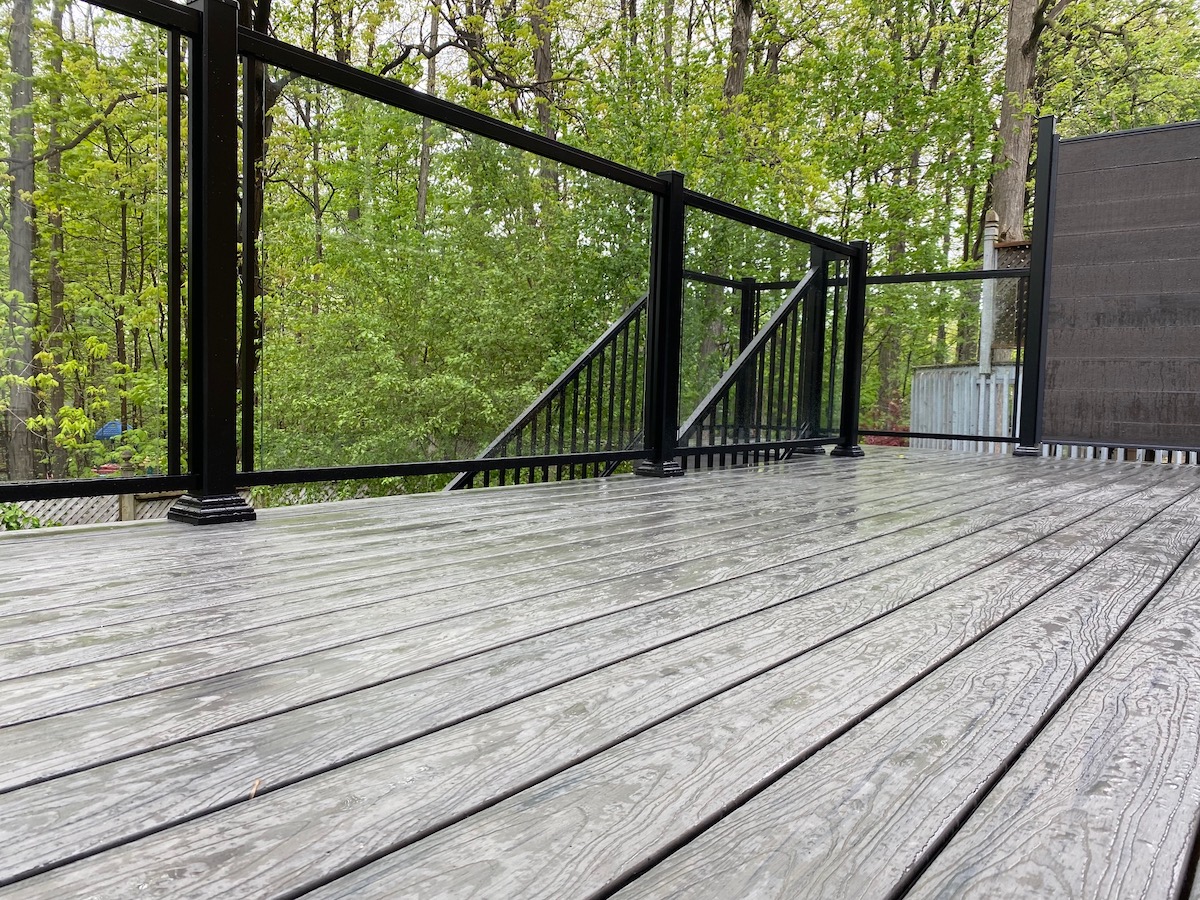
A composite deck is one of the best-value upgrades a GTA homeowner can make — but "how much does it cost?" rarely has a one-line answer. In Toronto and across the Greater Toronto Area, installed composite decks in 2026 run roughly $38 to $78 per square foot, and where you land inside that range depends on the board line, your deck height, railings, site access, and whether an old structure has to come down first. Below is a clear, current breakdown from a team that has been building decks across the GTA since 2004.
Composite deck pricing in the GTA, at a glance
"Composite" is not one product, so it does not have one price. It helps to think in three tiers, each with its own material cost and, usually, its own warranty and finish. The figures below are fully installed 2026 CAD pricing — labour, fasteners, standard aluminum-and-composite substructure, and a basic railing — not just the boards.
- Entry capped composite (~$38–$52/sq ft): A polymer shell over a wood-fibre core. Excellent value, strong fade and stain warranties, and a huge colour range. Ideal for larger footprints on a budget.
- Premium capped composite (~$50–$65/sq ft): Denser boards, richer multi-tonal streaking, and more realistic grain. The most popular tier for GTA homeowners who want a high-end look without full PVC pricing.
- Capped polymer / PVC (~$58–$78/sq ft): Fully synthetic, no wood fibre, the lightest and most heat- and moisture-resistant option. The premium choice for pool decks, low-clearance builds, and anyone wanting the longest service life.
If you want a number tailored to your exact footprint, our deck cost calculator lets you plug in size, height, and railing type for a fast GTA estimate before you ever pick up the phone.
Total composite deck cost by size (2026 GTA)
Most homeowners think in dollars, not per-square-foot rates, so here is what the tiers translate to for three common deck sizes. Ranges reflect real variation in height, stairs, and railing choices.
| Deck size | Entry capped composite | Premium composite / PVC |
|---|---|---|
| Small (~200 sq ft) | $7,600 – $10,400 | $10,000 – $15,600 |
| Medium (~320 sq ft) | $12,000 – $16,600 | $16,000 – $25,000 |
| Large (~500 sq ft) | $19,000 – $26,000 | $25,000 – $39,000 |
A ground-level rectangle with a single step lands at the low end; a raised deck with stairs, glass railings, and a wrap-around shape pushes toward the top. For a deeper look at line-by-line pricing, our Toronto deck cost guide for 2026 breaks the numbers down further.
Price by board type and brand
Brand and product line are the single biggest lever on material cost. The table below pairs each tier with its 2026 installed rate and the specific lines we build with most often across the GTA.
| Board type | 2026 installed cost per sq ft | Example lines |
|---|---|---|
| Entry capped composite | $38 – $52 | Trex Enhance, Fiberon Good Life, Deckorators Vista |
| Premium capped composite | $50 – $65 | Trex Transcend, TimberTech PRO & EDGE, Fiberon Concordia |
| Capped polymer / PVC | $58 – $78 | TimberTech AZEK (Vintage, Harvest), Fiberon Paramount, Deckorators Voyage |
How do the brands compare on price? Trex anchors the entry and premium capped-composite tiers and is often the value leader per square foot. TimberTech spans both, with its AZEK PVC lines sitting at the top of the market for heat resistance and realism. Fiberon tends to price competitively across all three tiers. If you are weighing the three head-to-head, our Trex vs. TimberTech vs. Fiberon comparison is a useful next read, and you can see finished projects in each brand in our Trex deck builds.
What actually drives your final price
Two 320-square-foot decks can differ by $8,000 or more. The boards are only part of the story — these are the factors that move the number most.
Substructure and footings
Everything sits on the frame. In the GTA, footings must reach below the frost line — typically 1.2 metres deep — and a raised or free-standing deck needs more of them. Many premium builds also use an aluminum or steel substructure, which resists rot and levels perfectly but costs more than pressure-treated framing.
Deck height and stairs
A deck 600 mm off the ground is far cheaper than one off a second-storey walkout. Height adds framing, guards, and often a longer stair run — and stairs are labour-intensive, so each set can add $1,500 to $3,500 depending on rise and material.
Railings: glass vs. aluminum
Railings are the most underestimated line item. Powder-coated aluminum is durable and mid-priced; glass panel railings can double the railing cost but open up a view. Composite-clad posts with aluminum balusters strike a popular middle ground.
Permits, access, and demolition
Most GTA municipalities require a building permit for decks attached to the house or raised above roughly 600 mm — budget for the permit fee and drawings. A tight backyard with no rear access means materials are carried through the home, adding labour. And tearing out an old deck typically adds $1,500 to $4,000 for demolition and disposal.
Why composite costs more up front — and wins over time
Pressure-treated lumber is cheaper to install, usually $22 to $32 per square foot in 2026. So why do most of our clients still choose composite? Because a capped composite or PVC deck never needs sanding, staining, or sealing, and it carries a 25-to-50-year fade-and-stain warranty. Over a 25-year horizon, the staining, boards, and time a wood deck demands often erase the up-front savings — a comparison we lay out in detail in our composite vs. wood cost and lifespan article. For most GTA homeowners staying in their home, composite is the lower lifetime cost, not the higher one.
Labour vs. material: the typical split
On a standard GTA composite build, expect materials to make up roughly 45–55% of the total and labour the rest. Complex builds — multi-level, curved, or heavy on stairs and glass — tip toward labour; simple rectangles on grade tip toward materials. This is also why a quality installer matters: skilled framing and fastening are what make an expensive board last its full warranty. As a WSIB-insured, three-time HomeStars "Best of" winner (2022, 2024, 2025) and Home Depot Pro partner, we price transparently so you can see exactly where your dollars go — you can browse our composite work through our Toronto composite deck builders page.
Frequently asked questions
How much does a 300–400 sq ft composite deck cost in Toronto?
Plan on roughly $12,000 to $25,000 installed in 2026, depending on tier and features. An entry capped composite at grade sits near the low end; a premium or PVC deck that is raised, with stairs and glass railings, approaches the top.
Do I need a permit for a deck in the GTA?
Usually, yes. Most municipalities require a permit for decks attached to the house or raised above about 600 mm off grade. Rules vary by city, so always confirm with your local building department — we handle permits and drawings for our clients as part of the build.
Is composite really cheaper than wood in the long run?
For most homeowners, yes. Composite costs more to install but eliminates decades of staining, sealing, and board replacement. Over 20-plus years — the same span we have been building decks — the maintenance savings typically outweigh the higher up-front price.
What is the easiest way to lower my composite deck cost?
Keep the shape simple, stay closer to grade to reduce framing and stairs, choose aluminum railings over glass, and select an entry capped composite line. Those four choices alone can shift a build by several thousand dollars without sacrificing durability.
Ready for a firm number on your project? Try our deck cost calculator for an instant estimate, then contact Deck Master Inc. or call 647-349-6585 for a free, no-pressure on-site quote anywhere in the GTA. With 20-plus years of local experience and a 5.0 rating, we will help you build the right composite deck for your yard and your budget.